
Adventures with the Flight Sim Studios Boeing 727F in Flight Simulator
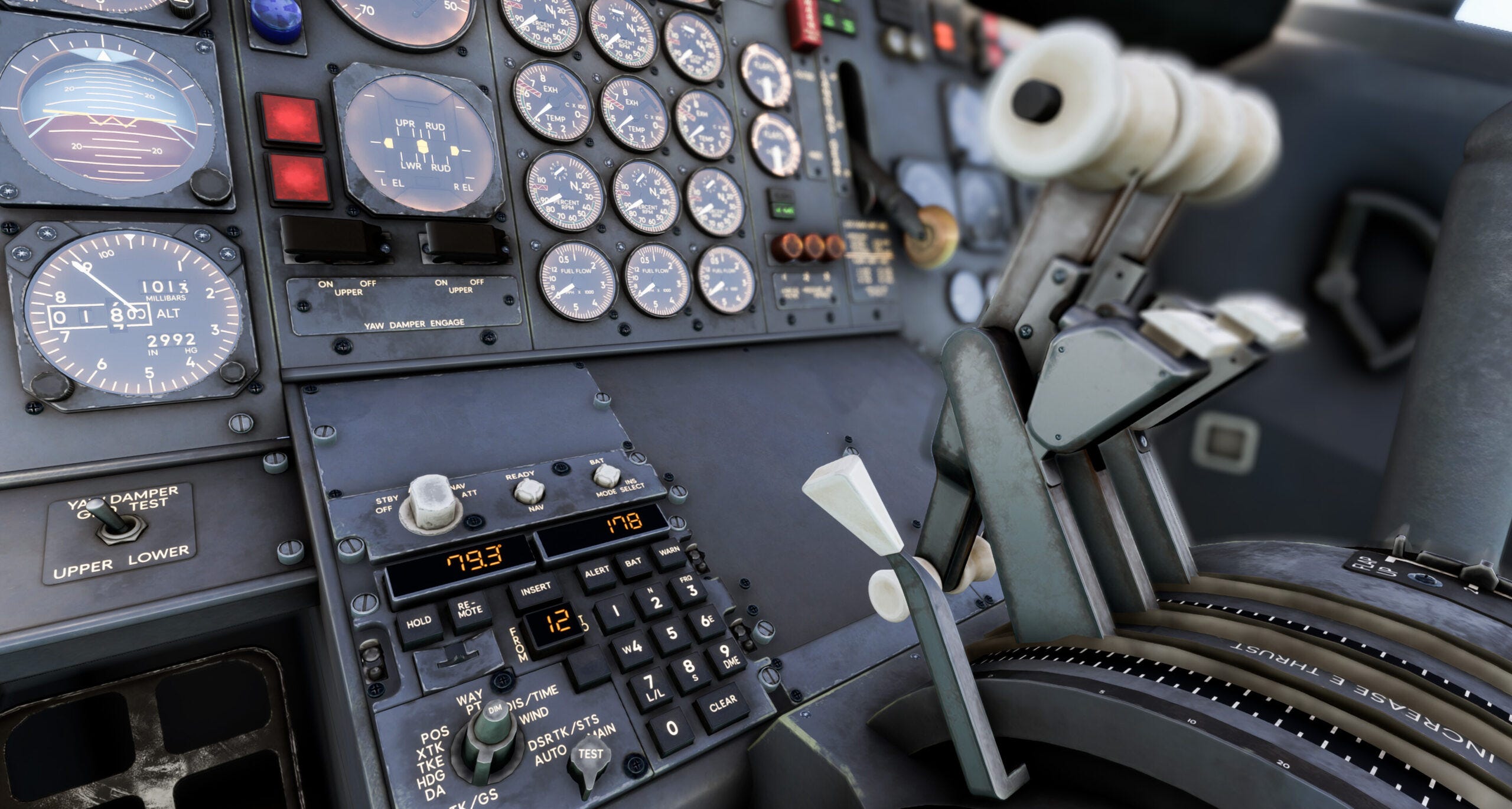
After completely missing the release of the SimWorks Studios Boeing 727-200F for Flight Simulator last week, I finally bought it on Saturday afternoon, and then promptly lost the entire weekend learning my way around it.
To say it’s a handful is an understatement - but completely understandable, given that it accurately simulates the workload of an airliner from an era before automation had arrived. The three man crew - pilot, copilot, and engineer - would have been busy - so it’s some relief that an automated engineer of sorts has been built into the aircraft.
What fun is that though? Letting the simulator take over with flicking switches and turning knobs in response to a living, breathing pile of several million moving parts?
So yes - it took all of Saturday and Sunday to work my way around the cockpit, read the copious online documentation, and begin to understand how the aircraft works.
The simulation of the inertial navigation system (it pre-dates GPS by some distance) is novel, and required a spreadsheet to help me programme the damn thing. I did it though, and I’m slowly learning the sequences of button presses to do common things - like for instance, making the aeroplane fly to the next damn waypoint! :)
Here’s the thing though - as much as the CIV-A INS is a historic piece of unintelligible hardware, and as much as it causes flashbacks to 1982 video recorder timer programming, you don’t actually have to use it. Most airlines didn’t because it was hideously expensive.
It turns out most 727-200s spent their life flying VOR to VOR, and doing DME approaches by hand (which makes total sense, when that’s what you’ve got in the cockpit).
The steepest learning curve in the entire aircraft has been the air pressurisation system. Or at least steep until a key insight fell into place. The 727 has three engines. The 727 is very powerful. You can climb faster than the cabin pressurisation can adjust for - which causes the most annoying claxon in the known universe. If you step climb, or just moderate your climb rate, the aircraft manages to keep up with you, and the cockpit it mercifully free of wailing, buzzing reminders of your own incompetence.
You can retro-fit the 727-200 with more modern GPS units such as the Garmin 530, or the GTN 750. They work wonderfully well - although it’s worth remembering that the flight directors and autopilot are two separate units, and both have to change settings when switching modes. It’s surprising how quickly it becomes second nature. Of course having learned every corner of the various Garmin units is now paying off - earlier I flew a complex race-track STAR into Barcelona, and was genuinely impressed at how well the aircraft handled it (with a little help from me - it doesn’t have VNAV or auto-throttles).
All in all, I’m hugely impressed with the 727 - particularly as it’s still at version 1.0. There are bugs - lots of small bugs - but nothing that’s going to annoy you that much. There is a much bigger sense of accomplishment flying the earlier airliners - at least in my mind - because there is just SO much to learn and do.
Anyway. There you go. 727. I’ll be dreaming about it probably.
It is a bit of a frame-killer in the sim, if you were wondering. I guess simulating so much of a complex airliner is quite taxing for the simulator.